Patrick Goddard
Hot Cadavers
➝ Download Press Release
“I’m talking to you about solidarity with students and workers, and you’re talking to me about tracking shots and close-ups! You’re idiots!” At the height of the events that led to the famous May of 1968, Jean-Luc Godard, the great name of the French New Wave, was caught exchanging accusatory words with other filmmakers. The issue was what to do to help the cause. For him, when faced with pressing practical matters, the cinematographic technique had little power. In the nick of time, solidarity ought to be done without a camera in hand. This schematic separation between art and politics, in any case, wasn’t so stuck as Godard himself would probably later have admitted. Art and politics mingle in complex, dialectical ways. In the end, solidarity and tracking shots belong to the same endeavor—a comprehension shared by Patrick Goddard’s view on the possibilities of art as a political medium.
In Hot Cadavers, Goddard’s (born in 1984 in London) first exhibition with GNYP Gallery, he presents new and recent works in various media: sculpture, drawings, and film. Despite the variation, there is a theme to which they tend to converge—that of “The Wild.” Something the artist understands as a big outsider. That is, outside of capitalist relations, outside of civilizational rules, and regulations, and outside, one could add, the rules that separate different media. That realm, fundamentally chaotic, finds some coherence in the world created by Goddard. In his works, several of our contemporary crises are understood through the lenses of this outsider. Still, we are welcomed not only to mourn the results of such ongoing predicaments, like the climate emergency, or the refugee crisis, but also to question and investigate what led things to this state of affairs. When facing a work like “Migratory Birds,” for instance, or even “Skirmish,” we can’t help but inquire what exactly is going on. But while the first work may lead us to lament, given its somber connection between migration and Anthropocene, in the second one, we may realize even with some amusement, that the notions of inside and outside, local and external, are much more porous than are often assumed to be.
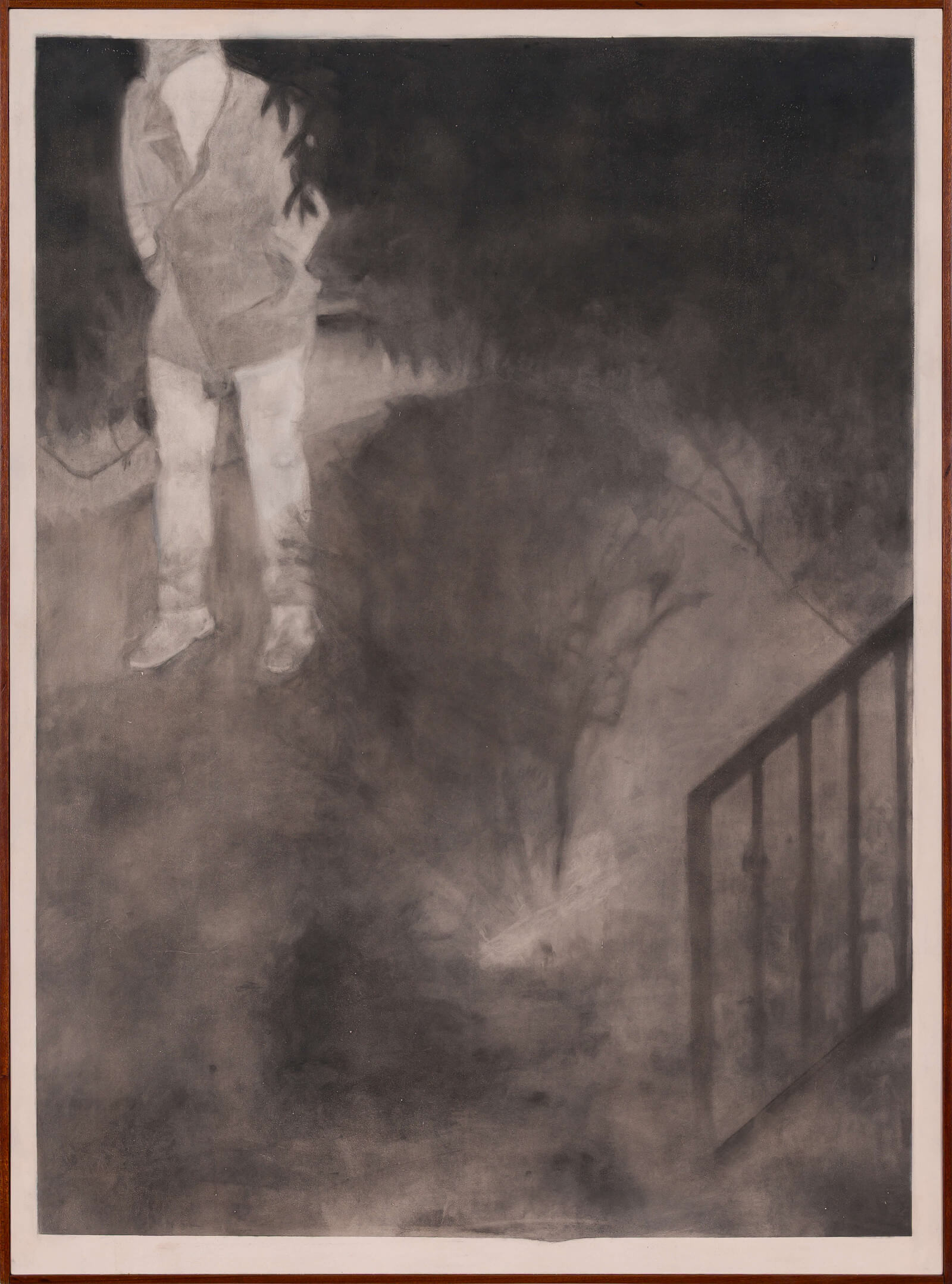
This same dynamic between static melancholy and witty reflection can also be found in another pair of works. In “Ghost! (20),” the exclamation point delivers the impact: given the sheer size, the lighting, and the motive itself, the viewer’s first response might be more of awe than anything else. However, in “Whoopsie’s Dream,” once again absurdity is transformed into examination. The comparison between immigrants and animals, full of consequences and historical warnings, is represented through a different key, indifferent to the common boundaries between genders, political inclinations, and eventually viewer response. Yet politics is not just about denunciation; even if timid, there is always a small hint of utopia. In his recent charcoal series “Denizens,” Goddard manages to discover and celebrate a new wilderness in the heart of the city; a wild space unfolds even there, where all possibilities of life seemed exhausted. Such dynamics, on another level, also remind us that nature always ends up transforming itself. Despite the grim scenario that we are apparently condemned to reproduce, corpses give rise to other organisms that in turn repopulate and disorganize what we thought was stable and known. Despite the grim scenario, someone will still have the last laugh. And it won’t be us.
Text by João Gabriel Rizek
Dutch version:
Op het hoogtepunt van de gebeurtenissen die leidden tot het beroemde mei 1968, raakte Jean-Luc Godard, de grote naam van de Franse Nouvelle Vague, verwikkeld in een felle woordenwisseling met andere filmmakers. De kwestie was wat er gedaan kon worden om de zaak te helpen. Voor hem had de cinematografische techniek weinig macht wanneer men geconfronteerd werd met urgente praktische zaken. Op cruciale momenten moest solidariteit worden getoond zonder een camera in de hand. Deze schematische scheiding tussen kunst en politiek was echter niet zo strikt als Godard zelf later waarschijnlijk zou hebben toegegeven. Kunst en politiek vermengen zich op complexe, dialectische manieren. Uiteindelijk behoren zowel solidariteit als tracking shots tot hetzelfde streven—een inzicht dat ook gedeeld wordt door Patrick Goddards opvatting over de mogelijkheden van kunst als politiek medium.
In Hot Cadavers, Goddards (geboren in 1984 in Londen) eerste tentoonstelling bij GNYP Gallery, presenteert hij nieuwe en recente werken in verschillende media: sculpturen, tekeningen en video’s. Ondanks de verscheidenheid is er een thema waarin ze allemaal samenkomen—dat van “Het Wilde”. Iets wat de kunstenaar begrijpt als een ultieme outsider. Dat wil zeggen: buiten de kapitalistische verhoudingen, buiten de regels en voorschriften van de beschaving en, men zou kunnen toevoegen, buiten de conventies die de verschillende media van elkaar scheiden. Dat fundamenteel chaotische domein vindt in de door Goddard geschapen wereld toch enige samenhang. In zijn werken worden verschillende hedendaagse crises gezien door de lens van deze outsider. Toch worden we niet alleen uitgenodigd om te rouwen over de gevolgen van deze aanhoudende problemen, zoals de klimaatcrisis of de vluchtelingencrisis, maar ook om te onderzoeken en te bevragen hoe deze situatie is ontstaan. Bij het zien van een werk als Migratory Birds, bijvoorbeeld, of zelfs Skirmish, kunnen we niet anders dan ons afvragen wat er precies aan de hand is. Maar terwijl het eerste werk ons tot klagen kan bewegen, gezien de sombere verbinding tussen migratie en het Antropoceen, realiseren we ons bij het tweede werk—misschien zelfs met enig vermaak—dat de begrippen binnen en buiten, lokaal en extern, veel poreuzer zijn dan vaak wordt aangenomen.
Deze dynamiek tussen statische melancholie en gevatte reflectie is ook terug te vinden in andere werken. In Ghost! zet het uitroepteken de toon: door de enorme omvang, de belichting en het onderwerp zelf zal de eerste reactie van de kijker er waarschijnlijk één van ontzag zijn. In Whoopsie’s Dream daarentegen wordt absurditeit opnieuw omgezet in onderzoek. De vergelijking tussen immigranten en dieren, beladen met consequenties en historische waarschuwingen, wordt hier op een andere manier weergegeven—onverschillig voor de gebruikelijke grenzen tussen geslachten, politieke voorkeuren en uiteindelijk ook de reactie van de kijker. Politiek gaat niet alleen over hekelen; er is altijd een kleine hint van utopie, hoe subtiel ook. In zijn recente houtskool serie Denizens slaagt Goddard erin om in het hart van de stad een nieuw soort wildernis te ontdekken en te vieren; een wild gebied ontvouwt zich zelfs daar, waar alle mogelijkheden voor leven uitgeput leken. Diezelfde dynamiek herinnert ons er, op een ander niveau, ook aan dat de natuur zich uiteindelijk altijd transformeert. Ondanks het grimmige scenario waartoe we blijkbaar veroordeeld zijn om steeds te reproduceren, geven lijken de aanleiding tot andere organismen die op hun beurt herbevolken en desorganiseren wat we dachten dat stabiel en bekend was. Ondanks het duistere vooruitzicht zal uiteindelijk iemand de laatste lach hebben. En dat zullen wij niet zijn.
Text by João Gabriel Rizek